The Evolution of Go-to-Market: How Modern Marketers Are Becoming GTM Engineers
Discover the new rules of Go-to-Market. Learn how modern operators use signal-based triggers, AI web scraping, and automated workflows to outpace 10-person sales floors.
For decades, Go-to-Market (GTM) strategy followed an expensive, brute-force equation: hire more human outbound reps, buy larger contact databases, send more generic emails, and hope for a fractional return on investment.
That model has completely collapsed.
Today, email deliverability algorithms aggressively penalize mass blasts. Ad costs across Meta and Google continue to rise. Decision-makers instantly ignore generic outreach.
In response, a new discipline has taken over high-growth companies: GTM Engineering.
The highest-performing growth leaders today are no longer managing bloated sales floors or writing copy in a vacuum. They are acting as systems architects, building automated pipelines that listen for real-time buyer intent signals, enrich prospect profiles using artificial intelligence, generate bespoke audits programmatically, and deliver value upfront.
Here is the complete history of how Go-to-Market evolved, how modern teams build AI workflows, and how marketers are transforming into part-time engineers to build self-driving revenue systems.
 Modern revenue growth is an engineering problem: building intelligent data pipelines that replace manual cold outreach.
Part 1: The Three Eras of Go-to-Market
To understand where GTM is heading, we have to look at the three distinct eras of customer acquisition over the last twenty years.
Era 1: Traditional GTM (2010 to 2020: The Brute-Force Headcount Model)
In the early SaaS and ecommerce boom, growth was purely a function of headcount:
- The Strategy: Companies hired armies of Sales Development Representatives (SDRs) whose sole job was manual prospecting, cold phone calls, and attending trade shows.
- The Technology: Heavy, centralized systems of record like Salesforce and basic spreadsheets.
- The Playbook: Buy a static database of 50,000 corporate contacts, split the list among reps, and have them dial 100 numbers a day.
- The Economics: High customer lifetime values (LTV) could support expensive human payroll, even with low conversion rates.
Era 2: Recent GTM (2021 to 2024: SaaS Bloat and Inbound Saturation)
The expansion of specialized cloud software created the era of fragmented point solutions:
- The Strategy: Growth shifted toward Inbound Marketing and high-volume digital outreach. Marketers created long PDF whitepapers and gated them behind email collection forms.
- The Technology: Companies adopted 20 to 30 disconnected tools: Apollo for leads, Klaviyo for ecommerce messaging, HubSpot for CRM tracking, and various automation webhooks.
- The Failure Point: Because every company ran the identical playbook, buyers developed banner blindness. Marketers relied on superficial personalization tokens (
"Hey {{first_name}}, saw you went to {{university}}") that fooled no one. In late 2024, Google and Yahoo introduced strict spam thresholds, effectively destroying mass-blast outbound deliverability.
Era 3: The Future (2025 and Beyond: The GTM Engineering Era)
We have entered the era of programmatic, signal-driven growth:
- The Strategy: Zero mass-blasting. Outbound only occurs when a verified trigger event happens (e.g., a store installs a specific app, a company hires a specific role, or a product experiences dead clicks on mobile).
- The Technology: Composable data layers combining workflow engines like n8n and Make, data enrichment engines like Clay and Storeleads, behavioral analytics via PostHog, and language models from Anthropic and OpenAI.
- The Conversion Asset: Passive PDFs have been replaced by free, interactive utilities and calculators that provide instant answers without requiring a sales call.
Part 2: The New Rules of Go-to-Market
The rules of customer acquisition have fundamentally changed across every operational dimension:
| Operational Area | The Old Playbook | The Modern GTM Engineering Playbook |
|---|---|---|
| Trigger Mechanism | Arbitrary calendar cadences | Real-time buyer signals (Job changes, tech stack shifts, ad scaling) |
| Lead Qualification | Manual SDR LinkedIn research | Automated AI scraping, multi-step LLM scoring, and fit filtering |
| Outreach Content | Asking for a 30-minute sales meeting | Delivering a bespoke 1-page visual audit or custom financial teardown |
| Lead Magnet Format | Gated 20-page PDF reports | Free un-gated tools (e.g., interactive calculators and scorecards) |
| Tech Architecture | Monolithic, locked CRM suites | Composable APIs, webhooks, and local database warehouses |
| Team Structure | VP of Sales + 10 manual SDRs | 1 GTM Engineer + Multi-Agent Automation Pipeline |
Part 3: The Anatomy of a Modern GTM Engineering Architecture
A modern GTM engine is not a single software application. It is an interconnected 4-layer pipeline:
Layer 1: Signal Capture & Web Scraping
High-performing pipelines do not buy static lists; they stream live signals.
- Tech Stack Detection: Using BuiltWith or Storeleads to detect when an online brand uninstalls a customer support widget or scales up their ad spend.
- Automated Web Crawling: Using Apify or headless browser scripts to monitor competitor pricing changes, forum discussions, and directory updates.
- Contact Discovery: Querying verified email APIs like Apollo only after a company passes strict qualification thresholds.
Layer 2: Product Telemetry & Search Intelligence
Modern GTM systems monitor both user behavior and organic search demand in real time:
- Product Behavioral Tracking: Using open, developer-friendly analytics like PostHog to see exactly where users drop off inside an application or web store.
- Live Search & SERP Telemetry: Connecting programmatic APIs like DataForSEO to track live Google rankings, People Also Ask questions, and AI Overview citations.
Layer 3: AI Reasoning & Qualitative Synthesis
This is where modern language models act as autonomous researchers rather than generic text writers:
- Deep Page Inspection: An AI agent visits the prospect’s website, inspects their mobile checkout experience, reads their customer reviews, and extracts their primary operational bottlenecks.
- Fit Scoring: The agent scores the prospect from 0 to 100 based on quantifiable unit economics (e.g., estimated monthly ad budget, SKU count, site speed score).
- Data Cleansing: Using automated sanitization tools like our free AI Text Sanitizer & Cleaner to strip robotic preambles and formatting artifacts before any communication is staged.
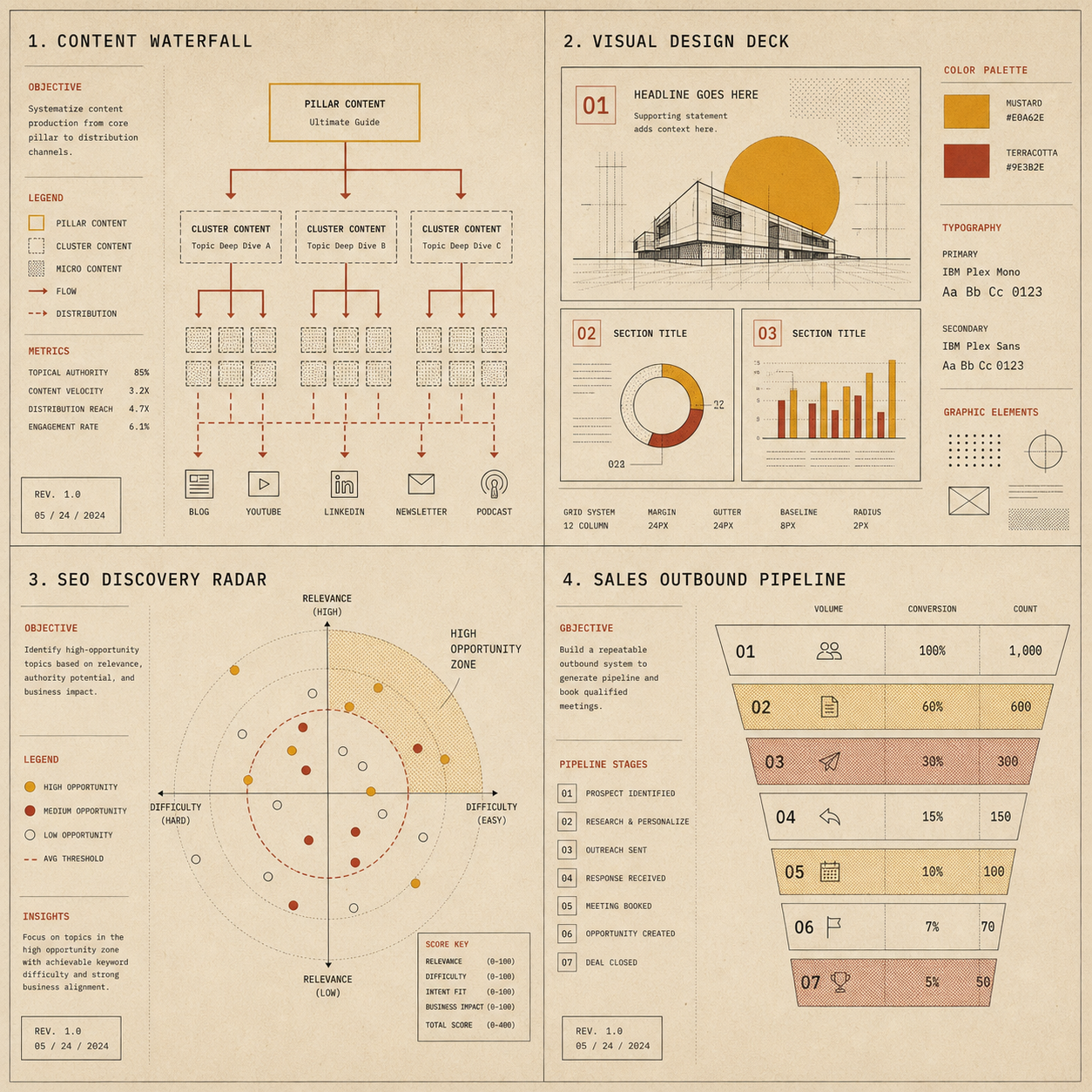 Multi-agent workflows replace fragmented manual departments by automating research, auditing, and dispatch.
Layer 4: Interactive Utility Anchors & Conversion
Instead of asking prospects to book a call, GTM engineers point them toward self-service interactive utilities:
- Margin & Ad Math: DTC founders use free tools like the ROAS & Margin Calculator to work out their exact break-even metrics before turning up ad spend.
- Operational Savings: Operators quantify labor savings using the Automation ROI Calculator.
- Conversion Auditing: E-commerce founders run their stores through the Store Funnel Health Scorecard to locate hidden checkout leaks.
 Delivering an objective, data-backed report card upfront converts prospects faster than any generic sales pitch.
Part 4: The Marketer-to-Engineer Transformation
The traditional marketer who only writes copy, manages calendar schedules, and configures email templates is facing rapid commoditization.
In their place, the GTM Engineer (a marketer who understands technical systems, APIs, and data architecture) has become the most valuable operator in modern business.
 The future belongs to the operators who can write the code and build the systems behind revenue generation.
The 4 Technical Skills Every Marketer Must Learn
- APIs and JSON Data Structures:
Modern marketers do not wait for native software integrations. They understand how to send a
POSTrequest, authenticate with an API key, and parse a JSON response containing search or lead telemetry. - Webhook Orchestration: Understanding how to connect event listeners across tools like n8n, Make, and custom Python scripts so that when an event occurs in one tool, it instantly triggers an automated workflow in another.
- Basic SQL and Database Management: Moving beyond messy spreadsheets by storing leads, measurements, and backlink records in lightweight, high-speed relational databases like SQLite or PostgreSQL.
- Agentic System Design: Knowing how to structure multi-stage AI prompt loops with strict boundaries, verification gates, and zero-shot evaluations so the system runs reliably without hallucinating claims.
Part 5: Real-World Walkthrough: The Signal-to-Conversion Workflow
Here is how an automated GTM workflow runs in the real world for a high-growth B2B optimization practice:
Step 1: Signal Detection
Storeleads API alerts: An online brand has scaled Meta ad spend past $20,000/month.
                         │
                         ▼
Step 2: Headless Browser Inspection
An Apify script crawls the mobile store and detects broken image swatch buttons.
                         │
                         ▼
Step 3: AI Arithmetical Teardown
A language model calculates revenue loss using standard break-even ROAS formulas.
                         │
                         ▼
Step 4: Dynamic Asset Assembly
The pipeline auto-generates a 1-page visual teardown PDF showing the exact bug.
                         │
                         ▼
Step 5: Human-in-the-Loop Review
The growth operator reviews the generated report in Slack and clicks "Approve."
                         │
                         ▼
Step 6: High-Context Delivery
A short 3-sentence note delivers the audit directly to the founder.
Response Rate: 22% (vs. 0.2% on generic cold blasts).
Part 6: How Lean Teams Can Start Building Today
You do not need a multi-million-dollar venture budget or a dedicated engineering department to implement GTM workflows. Follow this practical three-step roadmap:
- Audit Your Manual Routine: Write down the top three repetitive tasks your growth team performs every week (e.g., researching company headcount, checking website tags, calculating proposal quotes).
- Build One Interactive Anchor: Replace your static PDF lead magnets with a clean, focused web tool (explore utilities like the PMF Scorecard or UTM Campaign Builder for architectural reference).
- Automate One Signal Pipeline: Pick a single intent trigger (such as tech stack changes or negative review alerts) and use a tool like n8n or Python to automatically draft customized briefing cards for your team.
Conclusion
The future of customer acquisition does not belong to the largest marketing department or the biggest cold-email budget.
It belongs to the GTM Engineers: the operators who can write the scripts, configure the data streams, build the interactive tools, and deploy intelligent AI workflows that deliver undeniable value to prospects before ever asking for a transaction.

Tired of generic SEO fluff when searching for store fixes?
Google Search is packed with affiliate articles by people who never ran a store. Tell Google to prioritize real e-commerce field notes, working code, and honest math whenever you search.